
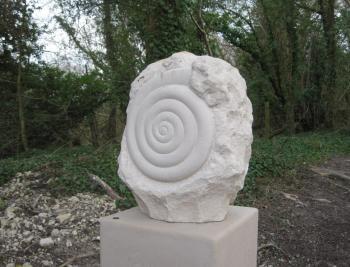
The rare Cheese Snail which lives in the Buriton Chalk Pits is now celebrated in Portland Stone - and two other sculptures on this new long distance walking and cycling route can also be found in the parish.
In total 20 new stone sculptures, which celebrate local heritage, are being unveiled on the route - and they are already encouraging more people to walk and cycle along the Shipwrights Way.
With only 20 sculptures along the 50-mile route, Buriton has done very well to see three of them located in the parish.
As well as the cheese snail, there is a carving of a Hampshire Downs sheep at a viewpoint overlooking grazing land near to the north-east corner of the Queen Elizabeth Country Park and a sculpture depicting the Roman Villa site slightly further south in the Park.

All the subjects were suggested by local people and then carved by artist Richard Perry from Portland stone.
Each sculpture depicts a story or aspect of the area where they stand and each has its own QR code that explains more about the carving. Full details can be found on the Shipwrights Way website: http://www3.hants.gov.uk/shipwrightsway/shipwrightsway-route.htm
The Shipwrights Way is a new long distance route which links villages and towns in east Hampshire through some beautiful countryside. The name reflects the use of oak grown at Alice Holt Forest for Tudor shipbuilding, linking this site with Portsmouth Historic Dockyard, home of the Mary Rose and HMS Victory.
Starting from Alice Holt Forest, the route passes through Bordon, Liphook, Liss, Petersfield, Buriton, the Queen Elizabeth Country Park, Staunton Country Park, Havant, Hayling Island and continues to Portsmouth via the ferry, finishing at the Historic Dockyard. As much as possible of the route is off-road, using rights of way and permissive paths, and it connects with seven rail stations.
The Buriton cheese snail, actual size about the size of your fingernail, now lives in the old chalk pits, once a place of work and now peaceful and full of wildlife
The carving of a Hampshire Down sheep aims to reflect the long history of grazing on the downs. Sheep are still an important part of the landscape today, helping to manage the beautiful chalk downland whilst providing delicious local meat.
Details of each of the three sculptures in the parish can be found here:
http://www3.hants.gov.uk/shipwrightsway/shipwrightsway-sculptures/sculpture-snail.htm
http://www3.hants.gov.uk/shipwrightsway/shipwrightsway-sculptures/sculpture-sheep.htm
http://www3.hants.gov.uk/shipwrightsway/shipwrightsway-sculptures/sculpture-villa.htm
